" For, lo, the winter is past, the rain is over and gone; the flowers appear on the earth; the time of the singing of birds is come, and the voice of the turtle is heard in our land. " Song of Solomon
Showing posts with label nutrition. Show all posts

February 23, 2011

DON'T BE TOO HARD ON YOURSELF


You Were Not Given Good Information.
So it is not all your fault.

 "With more fat-free products than ever, Americans got fatter....this focus only on fat calories to the neglect of carbohydrate calories has contributed to this epidemic of obesity."

The quote you just read is from Dr. Walter Willet.

Here are his credentials:

"Walter Willett is professor of epidemiology and nutrition at Harvard School of Public Health, a professor of medicine at the Harvard Medical School, and the author of Eat, Drink, and Be Healthy: The Harvard Medical School Guide to Healthy Eating. He is also one of the principal investigators on the Nurses Health Study, one of the largest, long-term studies to look at the effect of diet on health. Willett explains how his research on the Nurses Health Study led him to become one of the USDA food pyramid's greatest critics. "The food guide pyramid that was developed in 1991 really is based on the idea that all fat is bad," he says. "This pyramid is really not compatible with good scientific evidence." In this interview, he explains the reasoning behind his revision of the food pyramid to include exercise at the base and to separate out "good" and "bad" fats and carbohydrates. This interview was conducted on Jan. 9, 2004."  (From the sidebar at the pbs link below.)

If you'd like to read the whole interview--and I suggest you do because not only is it informative, it is  important information. 

FAT IS NOT THE ENEMY.  

And it is easy to read, in lay terms. 

Go to this link:

http://www.pbs.org/wgbh/pages/frontline/shows/diet/interviews/willett.html


February 12, 2011

New Love

 I ♥  smoothie--in a bowl!

Why? 

It tastes great.

It's an easy way to get 2-3 servings of fruit.

And if you eat it in a bowl versus drinking from a glass, it lasts 'forever'.  You'll have a heap big bowl of wonderfulness.

And you'll be stuffed.  And satisfy your sweet tooth at the same time.

It's like a fruit soup.  
 And it's cold like ice cream because I use frozen fruit or add some ice. 

And you can add toppings like granola, nuts, coconut--even Magic Shell topping, all of which makes it like dessert! Dessert that is GOOD for you.  That you can feel GOOD about eating.  And that tastes GOOD to boot

I like to throw in half a scoop of protein powder for whey protein (which staves off hunger) and some plain yogurt or milk for calcium as well as protein,

And I usually add some flax meal for fiber.  Or some chia seed, which I grind first due to diverticulosis.

And always--for the B vitamins (plus protein and fiber too) --my beloved nutritional yeast.

I've been eating it every day and my weight is at a new low by a few ounces.

And I feel great.

Maybe it's psychological.  Or maybe it's not.

No matter. 

The proof is in the pudding--or in this case in the fruit bowl.

*******************************
Note:  It's not necessary to add all of the above to your smoothie in a bowl.  Just use what you have on hand and see if you like it.  I always buy bananas, and I keep frozen fruit in my freezer--strawberries, blueberries, or peaches. Begin with one or two fruits, enough to equal two servings, add some liquid --like milk, yogurt and/or water--and blend away.  Usually the fruit is sweet enough for me, but you can add a little sweetener for taste if you desire.

I got the idea for smoothie in a bowl from KERF--i.e, Kath Eats blog.  I thought 'what's the big deal about eating it in a bowl?'.  Well, I found out. 

When I drink it down, I guzzle it.  Eating it with a spoon from a bowl takes longer and yields more pleasure and satisfaction--something any of us who are trying to lose weight need more of.

For pictures of smoothie in a bowl check out KERF.


February 8, 2011

Just A Thought


MAYBE

.....it's not what we eat that matters.....

But what we don't eat .


January 10, 2011

Triglyceride Primer

Your total cholesterol is a count of lipids in your blood stream.

Usually the HDL (high density lipoprotein), LDL (low density lipoprotein) and triglycerides are measured separately.

Hence, triglyceride is found in the blood.

(The 'experts' say high triglycerides increase your risk for cardiac event or disease.)

What are they?

The short answer is they are a fat--a lipid.

How do you accumulate them in your blood?  From eating fat?

Nope.  Carbohydrates are the culprit.

The simplified explanation:

When you eat carbohydrates it is converted--by your body--into glucose.

That glucose fuels your cells.  Any excess glucose is returned to your liver.

Once there,  the liver coverts that excess glucose to glycogen.  

Glycogen fuels your muscles.

When you 'move' you use your muscles and they burn glycogen for fuel.  

Your muscles store glycogen--so it'll be available when needed.

If you are a body builder with lots of muscle volume you'll need more glycogen than someone who is not.  

What happens to the excess glycogen not used and not stored  by your muscles?

It goes back--ta da--to your--you guessed--LIVER.

(Gee--I'm beginning to think the liver is a big deal--it works hard.)

The liver turns the excess glycogen into fat--i.e. triglyceride.

Some of that fat goes into fat storage.

(You'll find it on your tushie, your tummy..you know .)

And the rest?...it circulates in your blood, where it can gunk things up.


If you want to reduce the triglycerides in your blood, you must reduce your intake of carbohydrates.

You can do this by reducing your overall food intake--in other words quit eating excess calories.

You can do it by reducing the percentage of calories that come from carbohydrates--in other words eat more protein and fat--the good kind preferably.

And you can do it by  moving those big muscles--which activity  uses the stored  glycogen--making room in your muscles for more to be stored.  The more that goes to the muscles for storage the less there will be floating around in your blood stream.

Ahhh---the mystery of triglycerides solved.


December 29, 2010

Heading Into the New Year: Focus on fiber and cinnamon

If you'd like to get more fiber into your diet this upcoming year eat more beans.  They are a great source of fiber, cheap and good for you.

Yes they are carbohydrates, but complex.  Pass on the bread and eat  beans instead.

Fiber not only promotes regularity, it helps you fill full longer and it feeds the good bacteria in your gut.  And you want to feed that good bacteria--so it can control the bad bacteria population.


 As for cinnamon, it has several healthful benefits. Dr. Oz recommends it and I find him to be credible. When it comes to losing weight, 'they' say cinnamon helps by increasing metabolism.

And if you are diabetic or have insulin resistance issues, cinnamon has some proven benefits for those issues too.

In Asian cultures and Ayurveda  it is considered to be a warming spice.  And don't worry if it is Ceylon cinnamon or cassia.  Cassia is even higher in the beneficial elements than cinnamon per my research.

My goal is to consume a teaspoon of cinnamon every day.  The easiest way I find to ingest it is in a tisane.

Here's how I make mine.

CINNAMON GINGER TISANE

I bring some water to a boil.  While I wait on that I grate some fresh ginger into my cup--a good amount--probably a teaspoon or more-- I like it gingery and spicy.  To that I add a third teaspoon of cinnamon and a packet of stevia to sweeten it.  Then I add the water, about 10 ounces, and I let that steep, covered, for about 5 minutes.

If you don't like ginger omit it.  But be sure to allow the cinnamon to steep and soak up the water.  If need be, reheat it after steeping.  If you don't allow it to steep it will taste sharp instead of sweet.

December 7, 2010

Overheard in a Small Town Diner: A Dirty Little Secret


We were eating lunch when in walked two strapping youngish men.  

While they were waiting to be served the guests at an adjacent table were taking their leave.

They spoke about the weather, how cold it was.

One of the men said they lived on the mountain top and that he was originally from the cold northern clime of Indiana so he was used to it.

Mind you he didn't even have a coat on and it was 29 outside and snowing.

He said he and his friend were truck drivers.  He was asked if they were local or long haul.

He said they did a run to California and back.  That is when he told them the dirty little secret.

He said when they topped the hill entering the San Joaquin valley the sky overhead was brown; that the air pollution was horrible there in that valley where so much of our produce is grown.

And that the water they irrigate the crops with is unfit for drinking.

He told them to soak any greens from California--like salad--in water for 30 minutes.  Then rinse and spin in a lettuce dryer.

Now the secret is out. 

It makes me think this is the reason Californians make such an issue about food quality and safety.  

They know the dirty little secret. 

And now you do too.


July 8, 2010

Tomatoes in the Garden

We grow Cherokee heirloom tomatoes.  They have a concentrated taste, reminds me of tomato paste.  And they are a dark, almost purple, color.  They are my favorites.  And they are getting ripe, ready to eat.

This time of year with tomatoes abundant I like BLT's. But the typical BLT is heavy on the fat and calories and slim on protein.

Instead I have BCT's--bacon, cheese and tomato

Toast two slices of your preferred bread. Add a layer of thin sliced tomato.  Then put down a slice of fat free american cheese.  Top with 2 slices of bacon  (I use the Oscar Mayer pre-cooked bacon-2 slices are 35 calories and 3 grams of fat) that you break in half yielding 4 pieces-- so it'll cover the bread.  Now add another slice of fat free american and a final layer of tomatoes.  Salt, pepper and light mayo are optional.

Calorie count for this yummyness:

2 slices of bread 120
1/2 tomato sliced 15
2 slices fat free cheese 50
2 slices OM bacon 35
Total = 220
If you add a half tablespoon of light mayo you're in for an additional 25 calories.  BTW...fat total on my BCM is 3 grams.  Protein is 13 grams, equivalent to almost 2 ounces meat.

If you want more protein add a side of fat free cottage cheese.  One half cup of Breakstone fat free cottage cheese will give you 12 grams of protein for 80 calories.  Top it with the other half of your tomato and you've added a veg serving.  Dust with salt and pepper.  Chopped cucumber would be nice too.  Healthier and more filling than a side of potato chips.

Later when your sweet tooth hits eat a peach or have some watermelon.  Both are in season and taste great right now and will do your body a world of good.

Note:  To date my favorite fat free american cheese single is the Kraft brand.

March 30, 2010

Rethinking The Avocado

I've avoided the avocado for years due to its high fat content. But did you know a half avocado has:
140 calories
13 g fat (sat fat is 2.5)
8 grams of carb
8 grams of fiber!!
3 grams protein
1 gram sugar
350 mg potassium
 Look at that fiber number!  Look at the amount of potassium!  And with 8 grams carbs and 8 grams fiber it's almost a wash in terms of carbs.   It's a pretty good deal given that the majority of the fat is good heart healthy fat.

I had a half avocado in my fridge and a half cucumber that needed using.  So here is the salad I came up with.  It is 2 side servings or one large serving.  You could serve it for one and add some tuna for a full meal in a bowl.


Cucumber Avocado Salad

Peel and cube one half cucumber.  Cube half an avocado.  Top with Humnut Sauce . Salt and Pepper to taste.

Notes:  When I don't have hummus on hand I omit it, use some olive juice, a very small amount of cider vinegar and a little additional water if needed to provide more moisture in the Humnut recipe--you're looking for a saucy consistency.  


If you've never used nutritional yeast and want to try it pick up some at a health food store that has bulk bins. You can purchase a small amount.  Different brands taste different, but they all taste somewhat cheesy.  Many vegans sprinkle it on most everything--like you would grated Parmesan cheese.  It is loaded with B vitamins, though the B12 vitamin is not present and must be added.  Check the label if you want to make sure it has B12.  Did you know 'they' say that anyone over the age of 50 needs to supplement with B due to the body's decreasing ability to process the B12 in the food we eat.


I like using the nutritional yeast because it makes a thick cheesy sauce that is very low in calories and high in nutrients.  You could substitute any favored salad dressing.  Some lemon and a drizzle of olive oil would be good.

March 22, 2010

Ode to Joy and Another Sweet Topic or What You Should Know About Agave Nectar

Spring was ushered in yesterday and it was glorious.  Bright sunshine and warm air, no shirt sleeves needed!  After the long drab damp gray winter we've had it was glorious indeed.  Cheers to Spring!  She promises to be a beaut.

Another sweet topic here: Agave Nectar

If you are buying it believing it is a healthier option, you may want to think again.  I tried it, liked it, but did not like the high cost, so have not since restocked it in my pantry.  Good thing too.

Turns out it is highly processed and does not remotely resemble the original plant.  It has no nutritive value beyond providing calories...AND...worst of all in my book--the final product is mostly FRUCTOSE!!!

I avoid fructose.  Why?  It must be metabolized by your liver.  Sugar/glucose does not.  Fructose is metabolized in a way that your body is unable to get out the message that your are satiated, hence you will continue to eat.  Sugar/glucose does not do that.  For specific information about this google it.

Furctose should be avoided just like high fructose corn syrup/HFCS.  But it is hard to avoid if you shop at the typical grocery store.  It--as well as HFCS-- is added to almost everything. Some people think it is better for you than sugar/glucose.  According to the facts I've read, they would be wrong.  (I've found HFCS  in canned kidney beans!)

Read your labels, and limit your use of any products  that contain fructose or HFCS. You don't want to eat much sugar period, but it is better for you, by far, then fructose, HFCS, agave nectar, and even honey and maple syrup--both of which are also high in fructose.

I'm not implying these products are poison or that you should  fear them--just avoid them like a bad egg if you are concerned about your weight and your health.

All fruits contain fructose, but the ones we eat most often have the highest amounts--like apples, bananas, oranges.  The benefit though is at least the fruit has nutritive value as well as fiber.  So get your fructose from your fruit, but don't overdo even that.  A couple of servings a day of fruit are ideal...then bulk up on vegetables to meet your daily plant quota.

IF you've lived long enough--you'll remember that back in the day, when we weren't such a fat nation, soda contained no fructose, it had sugar/glucose.  Nor was fructose or HFCS in the bulk of our processed foods. I personally believe there is a correlation between the advent of fructose/HFCS being introduced into our food supply and the increase in obesity.  I'd bet the facts support that too, would I take the time to examine them.

Finally--and this is a whole other topic--back in the day our processed and fast foods contained palm oil and coconut oil which was discontinued when saturated fat became the bad boy.  Sadly, those two oils were superior to their replacement--corn oil.  And we were warned to eat 'oleo margaine', supposedly superior to butter.  With the push to replace butter with margarine we ended up eating trans fat by the truck load.  Today--we are being warned against that, and rightly so. 

It is wise to listen to reason, but when 'reason' is funded by those who stand to make a huge profit if they are believed, we must seriously question the advice.  It has always been and always will be:  

caveat emptor..LET THE BUYER BEWARE.

February 17, 2009

Money Saving Menu Idea

In a previous post I published a partial list of foods that are fairly inexpensive and provide some good nutrition. I've been using those items as a foundation for my grocery shopping. I like to keep those foods on hand. If towards days end I'm coming up short in the fruit/veg department, I can pour myself a serving of orange juice and eat a 1/2 c cup of applesauce and I've added '2' to the count.

Yes, I know it's better to eat an orange and an apple, but those aren't always in season and when they are they often aren't very tasty and still have a pretty hefty price. And...how many times have I just skipped the orange and apple because I don't want to prep it. I've had more low count fruit and veg days because of that thinking, so I decided I'd be better off to eat the 2nd best choice than skipping it totally. My daddy had a saying--"when you can't do the first best thing, do the next best thing". All too often our circumstances don't align with our wishes and we can kick against that, say 'oh well', throw up our hands in despair and do nothing..or we can do the next best thing, keep a merry heart, and be all the better for it.

Most days now, when grocery shopping, I grab one of those shrink wrapped packages of kielbasa--it's a sausage, a bit spicy, pretty high in fat but full of flavor. I offset the negatives by using it sparingly and get a big flavor boost.

You can use it many different ways, but one of my favorites is to pair it with cabbage and peas. I slice or dice a small portion of it, and along with some diced onions, fry it up in a skillet. When that's browned nicely and the sausage has released its fat I add in some cut cabbage and continue to cook, adding pepper and a little salt if needed--remember the sausage is salty. When the cabbage is half way done, I throw in some frozen green peas--in this dish I prefer frozen to canned. When the cabbage and peas are tender, I like to serve this with some rye bread or cornbread and some additional protein in the form of dairy--say maybe a side of cottage cheese, a glass of milk, or some yogurt with fruit. If there's applesauce in your pantry, it goes nicely too.

Granted the above is not gourmet food, but it is substantial and pretty healthy, and it won't strain your pocketbook.

A second way I use the kielbasa is in canned beans--like pinto beans. Again dice a small portion and fry up with some onion, then add a couple of cans of beans. Though cooking dried beans is cheaper, it does have to be planned ahead, so using the canned is quicker and not a budget killer. Cornbread is good with this too--in fact it's almost a necessity if you're from the South.

The world wide web is a cooks best friend when it comes to finding budget mindful recipes, so as time allows take advantage.

December 11, 2008

Protein Helps

Just a quick update to let you know that eating more protein during the day has eliminated my need to snack at night. I feel proud, but it really has nothing to do with will power or me resisting temptation. I'm less hungry when I get adequate protein which also results in me eating less of the insulin raising foods that increase the appetite. I've been checking the scale and my weight is moving down. Also my clothes fit more loosely--the bloat is gone.

I want to interject to those of you who do Weight Watchers--who tells you that there are no forbidden foods--the reason many of the foods are no points or very low points is because they want to lead you to eating the foods that are lower glycemic, lower fat, lower calorie and higher in protein because those foods don't increase the appetite. They also promote fat burning (fat becomes the energy source) in your body.

So, you see, there is a method to their 'madness' of using points instead of calories. The points system along with the healthy eating habits they teach lead you to eating foods that will help you be most successful. Still though I prefer to follow my own plan and believe in the long term I will have more success.

It has been hard though for me to eat--as in chew-- enough animal sourced protein. I have to work hard to get in 60 grams--which seems to be the ideal minimum number for me, though according to other sources I should be getting more.

I've had to supplement my food with some protein shakes (whey based--I'm not supposed to use soy--oncologist orders) to reach that 60 gram goal. To stay in my calorie range I keep it plain.

To a cup of cold water and a couple of ice cubes I add the protein powder, some vanilla, and some sweetener. I can add some instant decaf coffee and some unsweetened cocoa powder too for a mocha shake, but it does require using more sweetener..and even calorie free sweeteners set off my sweet tooth.

Now--the trick is for me to not get slack and quit tracking my protein intake. After a few days it's too easy to slip back into the old ways, thinking I've got things under control, ignoring the knowledge I have and not using it to my aid.

July 25, 2008

Vacation and Intuitive Eating

After eight days away from home with lots of eating out I’m one pound heavier than I was when I left. Not too shabby considering….

I mainly focused on the Intuitive Eating hunger scale, honoring my hunger and respecting my fullness ….though I did find it all too easy to be distracted.. It is difficult too, to maintain focus, when faced with lots of out of the ordinary treats and circumstances. It’s easy to slip into that old auto pilot routine of mindless eating. I managed to make some trade offs--going for the foods that I really wanted, craved or were not what I could get at home. Had I been able to keep up with my walking and weight lifting routine I may not have gained at all.

During the trip up and back, which is 10 hours by car I found it most difficult to make good choices because those choices are so limited. Not being one who wants to waste time stopping and eating, I mainly grab fast food--and order stuff I can eat while driving without making a mess of my clothes and the car. Hence no grilled chicken sandwiches---those are two fisted eats. I find that the chicken breast has a tendency to “squeeze” out like a slippery bathed baby or a greased pig. The regular cheeseburger or hamburger or even the chicken nuggets seem to be easiest and if I’m really hungry---and who isn’t when you’re riding in the car basically bored--I add some fries minus the catsup…all downed by a large caffeine laden drink so I won’t fall asleep at the wheel.

Breakfast is always a sausage biscuit plus coffee for the caffeine. I never eat those at home for several obvious reasons---so I look forward to them when I travel. To get some fruit in I usually grab an orange juice--easy to drink and drive--- despite the high calories and lack of fiber. Hey---we don’t live in a perfect world. In a perfect world all the fast food would be healthy, at least in my world it would be. Fruit and yogurt is out because eating anything that requires utensils is less than safe. Missing my mouth and having food end up in my lap could be so distracting that I might run off the road and end up in a ditch or worse….dead or maimed for life….none of which is what I consider “healthy”. So for “health’s” sake I go with the juice.

So I was riding along and thinking--you have lots of time to think when traveling alone by car for 10 hours--how could I minimize the damage with my fast food choices. That’s when Art Linkletter came to mind.

Mainly I remember him for his show “Kids Say the Darn'dest Things” back in the day. And, only God knows why, but also for his answer when asked how he lost some weight. His answer---I ate as I always do, I just cut everything in half.

Now that works if you basically eat the same thing everyday. But if you’re like me, it’s kind of hard to know how much half is…half of what you would eat? or should eat? Without any absolute eating patterns eating half won’t work for me.

Continuing to ponder I came up with my own take. Mind you also--for me to leave half of anything is a no go. Guess it’s all those years of being taught “waste not, want not” and “there are starving children in China”--- there’s no way I’m throwing out half of the food I order.

Here’s what I came up with. Lets use a burger as an example. Say it has 400 calories. One fourth of that burger is 100 calories. Now if I leave ¼ I’ve just saved 100 calories. Or I could leave 1/8 and save 50 calories. I could do the same with my fries. Those multiples of 50 or 100 add up to some pretty hefty calorie savings.

Leaving a fourth or eighth is doable for me. Leaving an 1/8 of my “small in size but high in calories” burger is like leaving a bite. That I can handle…but no way can I leave a half…unless that sucker is gigantic. And if I’m really hungry I’m not likely to be able to quit after eating 3/4s of a small burger….so leaving an 1/8 is ideal.

If I can “save” 100 calories at each of 3 meals and 2 snacks in a day, that adds up to 500 calories saved. And that computes to 3500 over a week which translates into one pound....either not gained, or possibly lost. At any rate, even saving 100 calories a day will result in preventing a gain of 10 pounds over a year or possibly an effortless loss of 10 pounds.

Bottom line: When I find myself in a calorie dense or food wise dangerous situation, if I only go for the foods I want, crave, can’t get routinely in the parameter of tasting good enough to continue eating and couple that with leaving 1/8 or ¼ of any or all of the choices, I should pretty much be able to eat what I want without feeling deprived and without having to count calories, which is often hard to do away from home. Those actions plus the element of eating just until full should allow me to eat, enjoy and minimize the damage.
******************************************
Summary: Strategy for eating in dangerous food situations when it is tempting to eat mindlessly

+++Choose what you want

+++Choose what you crave

+++Choose what you can’t routinely get

+++Eat your choices only if the taste justifies it…if you take a couple of bites and it doesn’t taste good, stop eating that particular food…replace it with something else if desired

+++Leave 1/8 of one or more of your choices on your plate

+++Stop eating when you feel full in the stomach so you won’t be overfull and miserable
*******************************************
Here’s a salad I threw together today: Raw broccoli: about a cup; Red onion: diced, amount to taste; Red bell pepper: maybe a ¼ cup: 4-5 black olives

Toss this with one tablespoon of Annie’s Goddess Dressing mixed with a heaping teaspoon of honey.

This offers lots of chew, good nutrition and eye appeal. I ate this with a single serve pizza. The pizza had 420 calories. When I was halfway through the pizza I was feeling like I was reaching the full mark, so I decided to leave ¼…but it tasted good and I didn’t want to stop---there goes that eating because it tastes good “devil“--- so I left just an 1/8.

That behavior allowed me to save 52.5 calories and I never missed that last big bite. Since I was home I broke off the crust and ate the best parts. I weighed what was to be left behind so I’d be sure to leave 1/8. And best of all----- I didn’t feel deprived.

June 8, 2008

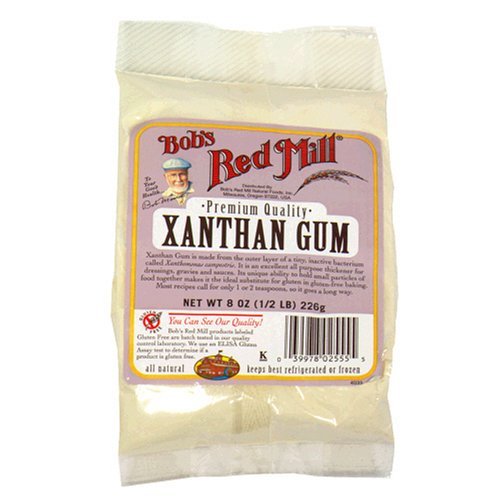
Xanthan Gum Powder


I rarely use purchased salad dressings preferring to make my own. Doing so, I am able to control the ingredients. Because I want to minimize the number of calories in my salad dressing I use less fat than the typical 2/1 or 3/1 ratio of oil to vinegar. To keep my dressing from being too tart I generally use some water to replace some of the oil.

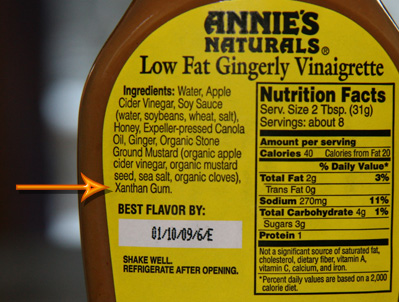
I discovered that by using xanthan gum powder, which is a natural substance and common ingredient in most bottled salad dressings---including Annie's Naturals line ---I could get a nicer consistency and thicker emulsion. I decided to bite the bullet and buy a package. It "weren't" cheap. Eleven dollars plus tax. But well worth the investment, because the package I purchased will last ages.


It only takes 1/4 teaspoon to bind one cup of dressing. The trick to getting it to work is this: you must flagellate it with metal. You can use a whisk and beat it hard for about 3 minutes, or you can use a blender or mixer. Once it binds it won't separate.

I've been using it in "ranch" dressing too. On the Internet I found a good recipe, tweaked it a bit and reduced the amount of mayonnaise by half and replaced the reduction with additional buttermilk/water plus yogurt/plain milk. The xanthan gum powder thickens it up and binds it together making a nice dressing.

You can use the powder as well in smoothies. I checked several protein powder smoothie mixes and they too have xanthan gum powder.

Mine was purchased at my local Kroger's in the health food section. It is the Bob's Red Mill brand. I imagine you can find it, too, at Whole Foods. If you can't find it locally you can order it online from Bob's Red Mill website.
************************************************************
Note: When using it combine with the dry ingredients like the salt, spices, sugar, then add the liquid/wet ingredients. 1/4 teaspoon is plenty for one cup of dressing. I estimated my package will do 275 batches of salad dressing.
***************************************************************
For more information on xanthan gum powder check out these links: here and here.

June 6, 2008

More on the ND Button And Rice Cakes Revisited

I recently did a post on the Nutrition Data button that is available on the Google Toolbar. Even if you aren't interested in having the button on your tool bar---which by the way is very handy if you count calories or need nutrient information for what you intake--you may want to use the site. At first it can be a little confusing. But once you figure it out, it is easy to use and gives some really good information if you're concerned about eating healthfully.

For example, I had some zucchini for lunch and was checking the calorie info and noted that the food summary provides an inflammation factor for each food. Having heard so much about the role inflammation plays in heart disease and health in general I looked a little closer. It appears zucchini is mildly anti-inflammatory.

As well, the food summary includes the estimated glycemic load -- useful information to a lot of us who prefer to eat foods with a lower GL. My zucchini was a 2. Note: Glycemic load is a way of expressing a food or meal's effect on blood-sugar levels.

Probably the most useful information in the summary is the Nutritional Target Map which categorizes foods relative to weight loss--foods that are lower in calories and will make you feel fuller.

For some this is a bit too much information---and we all do for the most part suffer from information overload....which can tend to be mind numbing. At any rate, some of the information may be a tool that will aid us in making better choices.

By the way--I gently cooked my zucchini and topped it with one wedge of Laughing Cow Light cheese--the French Onion flavor---(I broke the wedge into pieces), salt and pepper and buttery spray. I must say it was so delicious and the calorie count was 55 for that big bowl of yummy goodness. With it I had a couple of brown rice cakes spread with a dab of almond butter and topped with fresh spinach---that combination is almost an addiction for me currently. It's a little tricky to eat---the spinach wants to fall off---but the flavor and crunch is worth the messiness.

I'd never been a fan of rice cakes in the past, and still am not with the exception of the plain brown rice cakes...they are 35 calories each and, for me, it seems that almond butter was made for them. You may want to give them a 2nd chance if you've previously written them off.

February 11, 2008

HASTY TASTY STIR FRY


Recently I decided to add virgin organic coconut oil to my oil repertoire. Supposedly it has a lot of health benefits, equal to or surpassing extra virgin first cold pressed olive oil. One of the touted benefits is that it boosts the metabolism. I decided to give it a try.

I purchased the brand pictured on this post. It is solid at room temperature, is shelf stable, and has a divine coconut fragrance and taste. It is shelf stable indefinitely. It is not suitable for cooking at high temperatures but is suitable for sautéing and baking. I imagine it would make baked goods incredibly moist.

It can also be used as a skin moisturizer. When I was purchasing my jar a fellow shopper told me she gave it daily to her dogs for their coats, so that they'd shine. If it works for dogs, then maybe it will help my hair which is much dryer and feels more coarse since I entered menopause.

Price wise it is comparable to good olive oil. Since I don't do a lot of frying or baking it will go a long way.

Evidently it is a medium chain fatty acid and goes straight to the liver like carbohydrates do, thereby giving one immediate energy from its calories. Some say it is less likely to be stored as fat since it burns first like carbs.

Regardless of the health benefits, I love the flavor and I think it is a good substitute for shortening or butter. Although coconut oil is high in unsaturated fat, because that fat is medium chain, unlike butter which has long chain fatty acids, it is not supposed to be as harmful---if in fact saturated fat is harmful--- to our bodies.

From my reading I find that it was used extensively in food products in the U.S. until the 1980's at which time the soy and corn producers lobbied against coconut oil---it was "bad" for us---in favor of corn and soy oils. Because most of the coconut oil came from poorer countries they did not have the wherewithal to fight the corn and soy lobby, so it fell out of favor. I pause to question, does this switch from coconut oil to soy and corn oils have something to do with the increase in obesity we see today?

Prior to the 1980's, when coconut oil was the number one oil in manufactured foods, we were not as fat.

And as we all now know---or at least we‘ve been told-- the corn and soy oils that were pushed on us, being polyunsaturated oils, did in fact harm us. Upon the realization of this fact, mono-unsaturated oils took the throne and are still being touted today as best for us health wise.

So many of the decisions made for us seem to have a direct correlation to somebody’s bottom line, and I have to wonder where the truth is in all of it.

Now, for the recipe………….

I recently used my coconut oil in the following original recipe. It was delicious if I do say so myself, besides being quick and easy. The amounts are for one serving.

Hasty Tasty Stir Fry

½ tablespoon coconut oil
3 ounces of cooked pork, thinly sliced (or any cooked protein)
1-2 tablespoons diced onion
½ teaspoon of ginger-garlic paste
1 & ½ cups of frozen stir fry veg (thawed)
½ tablespoon Hoisin sauce
½ tablespoon Oyster sauce

In a non-stick skillet melt the coconut oil. Add the onion and ginger-garlic paste. Briefly stir fry, then add the thawed veg, giving it a good stir, followed by the cooked protein of choice. Continue stirring and add the Oyster and Hoisin sauce. Stir and fry until all is heated through. Just be careful not to overcook the veggies.

Serve over cooked rice or quinoa.

Enjoy!
*****************************************************
Next time you bake chicken breast or pork loin chops cook a few extra and freeze. With those in your freezer and a package of the frozen stir fry veg, and the oyster and hoisin sauces in your fridge, you’ve got the ingredients for a hasty tasty stirfry.

Also, I always freeze my leftover rice and quinoa. Both freeze beautifully. If you portion it into ½ cup servings it is easy to heat in the microwave or throw into your stir fry pan.

I save my pudding cups which happen to hold a half cup. You can put your rice and quinoa into these serving cups and then set them in a Tupperware container, or even slide them into a freezer bag.

I would advise, though, against heating the rice in those cups in the microwave. While they are food safe, they may not be microwave safe. Just slip the rice out of the cup onto your serving plate and warm in the microwave or throw the rice into your stir fry skillet to heat.

The cups are also great for shaping rice balls--I believe these are called onigiri--which can then be frozen. I like to fill my onigiri with canned salmon that has been mixed with a little wasabi and light cream cheese.

I didn’t believe it, but the frozen then thawed rice does taste great, unlike refrigerated rice, which to me, has an undesirable texture.

And while I’m at it, let me say I love my rice cooker. I’m all about having less stuff, but the great thing about a rice cooker is that you can put the rice and water in and walk away. No waiting for the water to boil, and then getting caught off guard and letting it boil all over your range top which then has to be cleaned in addition to the sauce pan. For years I thought it a foolish purchase when a sauce pan would suffice. But I wouldn’t be without mine now.
October 30, 2007

Why I Avoid 100 Calorie Packs


Whether sweet or savory, 100 calorie packs are mostly carbs; they generally contain minimal amounts of the macro nutrients protein or fat.

As so many of us today have been taught to avoid fat, I began ingesting a lot of sugar via mixed foods in an effort to do so. Fat has approximately 100 calories per tablespoon whereas sugar has just 50; hence the reduction in calories is huge and seemed to be a great trade off.

However, sugar is almost pure carbohydrate. One teaspoon of it weighs 4 grams and is 4 grams of carbohydrate. Three to 4 teaspoons of the stuff and you have almost the equivalent amount of carbs found in a slice of bread. That seemingly innocent 1 tsp stirred into my cup of tea for 16 measly calories wasn't so innocent. Three cups of tea later I could have had a slice of bread for about the same number of carbs.

The bigger issue though is how ingesting carbohydrates affects one's blood sugar. All foods have an effect, but simple carbs cause your blood sugar to spike, and even complex carbs elevate your sugar significantly. But what does this have to do with anything?

Well, when sugar (also called glucose) in the blood is elevated, insulin is released in response. The higher the sugar, the higher the insulin levels. And glucose is burned instead of fat, with excess glucose from excess calories finally being converted and stored as fat. And when too much blood sugar/glucose is stored away, the result is low blood sugar which triggers mood swings, hunger and carb cravings.

So, ingesting disproportionate amounts of carbs leads to mood swings, hunger and carb cravings, and instead of burning fat for energy, which is the goal of weight loss, we burn sugar/glucose which is like tinder in a pile of wood...it burns up fast and is gone and we straightway must add more wood to the fire. Or in the case of eating, we must eat more food, and continually.


Fat on the other hand, which most all of us are avoiding these days slows down digestion and absorption of calories. The result is blood sugar/glucose trickles gradually into the blood stream providing a steady ongoing supply of glucose, hence no mood swings, hunger or carb cravings. It is like those big split logs in the pile of wood... once they are lit, they burn slow, steady and long. And that is what we want when we eat...we want our ingested food to "burn slowly, steady and long" and keep us satisfied until the next meal.

The bottom line is this. Eat balanced foods. You need to eat fat with your sugar/carbs. Throw some protein into the mix and derive even more benefit from the metabolic process .

The temptation is still there for me, left over from my Weight Watcher days (I'm a lifetime member), to eat fat free or very low fat foods. The lowest point foods in the WW plan are also fat free. But when I do, I sabotage my efforts. I'm learning, slowly but surely.

Tip: A good balance of macro nutrients is a maximum of 50% of your calories coming from carbs, aim to achieve 30% from fat, and the balance from protein.

October 18, 2007

Could Your Breakfast Cereal With Eggs and Bacon Actually Reduce Your Risk of Heart Disease?

"What if bad fat is actually good for you? For decades, Americans have been told that saturated fat clogs arteries and causes heart disease. But there's just one problem: No one's ever proved it."

This quote is from an article by Nina Teicholz. To read the article in its entirety click here.

She summarizes her findings with this statement: "The message isn't that you should gorge on butter, bacon, and cheese," says Volek. "It's that there's no scientific reason that natural foods containing saturated fat can't, or shouldn't, be part of a healthy diet."
"....there have been many times when I have shed bitter tears, when if I had understood the situation better, I would have celebrated my good luck instead."

DISCLAIMER

I am not a doctor and all information, suggestions, etc are my personal opinion only.